
Trigger-based outbound for B2G sales teams
How government and education sales teams turn public buying events into trigger-based outbound: qualifying, scoring, routing, and timing outreach.

Outbound efforts into government and education accounts usually fail because of timing rather than copy. A district decides what to fund in the spring, and a rep reaches out in October with a list built the previous year.
This guide explains which public buying events qualify as outbound triggers, and how to score and route each one. It also covers when to run the sequence and how to prove that a trigger-based motion outperforms your static list.
What is trigger-based outbound in B2G sales?
Trigger-based outbound in B2G is an outreach motion in which a documented public buying event, such as an adopted budget line or an expiring contract, moves a government or education account into a rep’s queue with a named contact and a defined outreach window.
That window stays open for months rather than hours and closes when the buyer publishes an RFP. The sales team decides which public events qualify as triggers before writing any sequences.
Public buying events that qualify as outbound triggers
A public buying event qualifies as an outbound trigger when it is documented in a public record, has a date, and involves money or a decision your product affects. An event that fails any of those tests belongs in an account note rather than in a sequence.
The date is what makes a trigger actionable, because it tells a rep where the account is in its buying cycle.
Several event types pass that qualification test across state and local government, K-12 districts, and higher education:
- An adopted budget line that funds your category
- A board or council discussion of the problem your product solves
- A grant award with a spending deadline attached
- A contract expiration or renewal date at an account using a competitor
- A leadership change in a role that owns your category
- Strategic plan or capital plan language committing the account to the work
Budget triggers arrive on a schedule you can put on a calendar. A rep who tracks the publication and adoption dates knows when the district is making decisions and when the money becomes real.
Leadership triggers occur frequently enough to justify a dedicated play. The ILO Group’s Superintendent Research Project found that 114 of the top 500 districts, or 23%, replaced their superintendent in a single year, a figure 20% higher than the year before.
At that rate, a 500-account territory would see priorities and vendor relationships reset at more than one hundred accounts a year.
Why commercial triggers fail in government and education accounts
The standard trigger list in B2B sales was built for companies that raise capital, scale headcount, and install software. A school district does not close funding rounds, and its technology purchases rarely appear in tools that track changes in commercial stacks.
What government and education accounts do instead is decide in public.
Budgets are proposed, discussed, and adopted in documented meetings, and problems are recorded in board minutes before anyone writes requirements. Import the discipline of commercial trigger-based outbound, then replace its trigger list with the events that actually occur in government buying.
Score each trigger before a rep works the account
Score every trigger on four inputs. Without that scoring, a trigger feed becomes the same volume problem as a purchased list, just with better sourcing.
- Account fit: Entity type, size, and existing technology match your ideal customer profile.
- Identified Use Case: Institutions state a pain in a board meeting (or other public discussion) that your product or service can solve
- Funding evidence: Money is identified in a budget, a grant, or an existing contract line.
- Procurement stage: The account is deciding what to buy rather than evaluating submitted bids.
- Recency: The event happened recently enough that the people involved still remember it.
Funding evidence carries a date you can act on.
Forty-six states begin their fiscal year on July 1 and 44 states had enacted a full-year budget by that date for fiscal 2026, according to NASBO.
A line item approved in June becomes spendable money weeks later, so the score on that trigger should rise as July approaches and fall once that year’s money is committed.
Recency of the four inputs above needs a decay rule rather than a judgment call. A board discussion from last month and one from 14 months ago are not the same trigger, so set a half-life for each event type and let the score drop automatically.
Leadership changes are worth scoring exceptionally high on arrival, because leadership changes drastically affect spending priorities.
Route each trigger to the right account and contact
Each trigger type implies a different first contact, so routing rules are written per trigger rather than per territory. A budget line and a board discussion in the same district belong to two different conversations.
Write one routing rule per event type you work:
- Adopted budget line: Start with the finance director or business official who owns the line.
- Board or council discussion: Start with the department head named in the discussion, then add the superintendent or city manager.
- Grant award: Start with the program owner who has to spend the award before its deadline.
- Contract expiration: Start with the department head using the incumbent product, and add procurement once the renewal decision is live.
- Leadership change: Start with the new leader inside their first 30 days.
One contact is rarely enough when a technical evaluator, an economic buyer, and an end user all influence the decision. Add the second and third contacts to the same play, each with a clear reason to reach out.
Pushing triggers into your sequencer and CRM
Trigger programs lose their advantage in the handoff, when a trigger has to move from an alert into a sequence by hand. A trigger arrives, a rep copies it into a spreadsheet, and the context is a week old by the time the sequence launches.
Push the trigger into the CRM record immediately instead.
The account owner, the enriched contact, and the dated event text with its source link should go into your CRM and sequencer together, so the rep opens a queue that already contains the reason to call. Dedupe by account, and consider suppressing accounts already in an open opportunity.
Running that routing by hand across your entire TAM, which may include thousands of districts, cities, and campuses means reading agendas and minutes no one on your team has time to read.
If you want to automate the manual lead research process, consider Starbridge.
Starbridge is the AI GTM platform for companies selling to the government, K-12, and higher education, helping teams prioritize the right accounts, engage the right people earlier, and identify high-intent opportunities before the competition.
Your reps open a queue with a named account, a verified contact, and the event that justifies the call. The Buying Signals Monitor tracks 320,000+ government and education entities and pushes territory-matched buying indicators into your sequencer.

GovWell booked five meetings in its first week from Starbridge buying indicators and now sources 15% of the total qualified pipeline from Starbridge.
“The intent signals are incredibly powerful. Starbridge makes it easy to configure alerts so sellers receive high-intent signals for their territory,” says Shane Lieberman, Head of Business Development at GovWell.
Sequencing rules for each trigger window
Outreach begins within the window opened by the trigger, and the sequence length aligns with the procurement stage of the buyer.
The 24 to 48 hour response rule common in B2B trigger-based outbound assumes a buyer who can act within the current week. A district that adopted a budget line in June may not run its evaluation until October.
So, set the start delay by event type:
- A leadership change warrants a first touch within the new leader’s first 30 days.
- A board discussion warrants a touch within a few days, while the meeting is still fresh for the people who attended it.
- A budget adoption warrants a touch as the fiscal year opens and the department starts spending against the line.
Set the sequence length based on how far the account is from a decision based on their internal purchasing agenda.
- An account in early problem definition deserves a longer, lighter cadence built on case studies and peer examples, measured in months rather than a two-week burst.
- An account with budget and a named requirement deserves a compressed sequence with a meeting request in the first message.
Build the purchasing path into the message before the window closes. Maryland’s state procurement manual has agencies consider internal resources, existing statewide contracts, and preferred providers before running a competitive procurement.
A vendor already accessible through an existing contract can be purchased without an RFP, so reps should highlight that path early.
Starbridge has a built in ‘Navigate Procurement’ feature that allows reps to discover the preferred procurement path of buyers early.

Once the procurement path has been identified, Starbridge also gives vendors access to contract vehicles that can shorten the procurement process significantly by bypassing the RFP process.
Start with one trigger and one territory
A trigger-based motion does not require rebuilding your entire outbound program.
Pick one event type your team can reliably source, then write the qualification test and routing rule for it. Run that trigger in one territory, and hold a comparable set of accounts on the static list so you can compare the results.
When the comparison holds, add the next trigger type. When it does not, you learn something specific about your buyers rather than about outbound in general.
Starbridge helps govtech and edtech teams identify buying events across 320,000+ government and education entities, route them to the right rep with a verified contact, and work them from the first public record to a closed deal. Book a demo to see the triggers already active in your territory.
Frequently asked questions
A trigger event is a documented change at an account that creates a reason to reach out immediately. In government and education selling, that means a budget adoption, a board decision, or a contract expiration, each carrying a date a rep can act on.
Begin while the account is still defining the problem and deciding what to fund, usually a budget cycle before any solicitation. Once requirements are drafted, a challenger is arguing against a specification that someone else helped shape.
Intent data infers interest from browsing behavior and content consumption. A B2G trigger is a documented public event with a date and a source document, such as an adopted budget line or a board vote, so a rep can quote the record in the first message.
Yes. Route the account, the verified contact, and the dated event text into your CRM and sequencer together. It’s possible to set custom rules for how each trigger is routed.
Ignore published benchmarks and measure against your own static list. Run the triggered list and the static list for a quarter with the same reps and messaging framework, then compare reply rate, meeting rate, and meetings per hundred accounts worked.
Explore our use case library
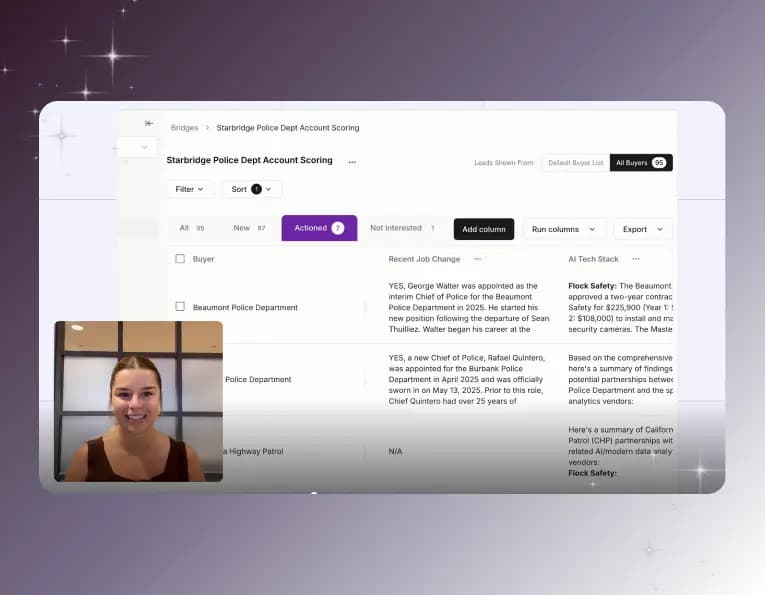 Automate account research with AI agentsStop manually researching accounts. Starbridge AI agents automate account research by monitoring buying signals 24/7 and surfacing the right contacts.
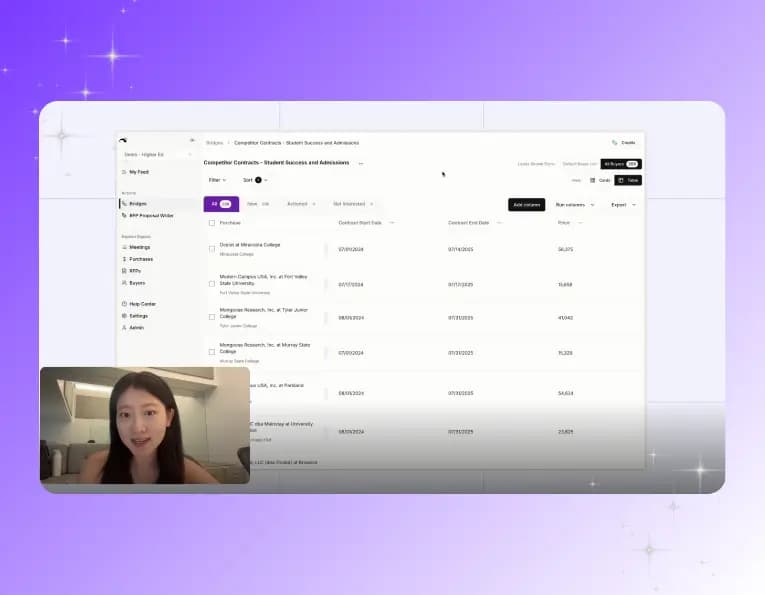 Identify competitor contract expiration datesThe RFP is usually a formality. Starbridge surfaces competitor contract expiration dates so your reps reach accounts before the renewal cycle closes.
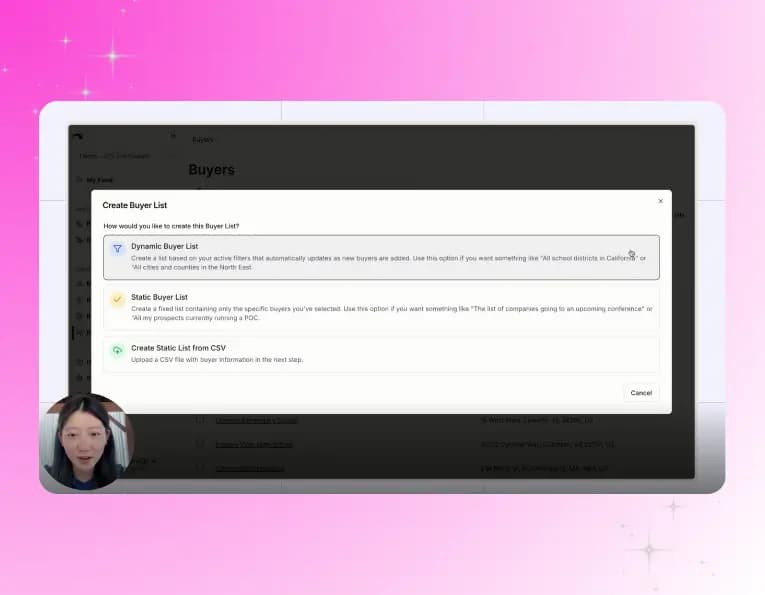 Create a conference campaignTurn conference badge scans into pipeline. Import your contact list, surface buying signals across every account you met, and follow up with context.